 ConnectOnion
 1.9.3rc16 (release candidate)
Stable remains 1.9.2. This preview requires Python 3.11 or newer and retains rc15's dependency floors and optional-extra security fixes. No dependency is upgraded by this candidate.
A slow pointer no longer accumulates every old approach step
An async click approach now skips intermediate points whose pacing budget has already elapsed. It still awaits the exact target, preserves overshoot/dwell behavior and sends one down/up sequence. Generic pointer moves and hover keep their existing behavior. Driver errors and cancellation still propagate.
In an isolated native headless fixture, a 1-second delay on each dispatched move changed one click from 51.18 seconds/50 moves to 5.36 seconds/5 moves. Healthy dispatch remained about 1.15 seconds/50 moves. These are controlled fixture measurements, not a promise of that speedup on every page. The earlier production cadence's root cause remains unproven. Fresh headed and headless native fixtures exercised exact-target clicks; the headed run did not establish a hidden/background-page control.
A scoped O Chat consumer journey verified invite onboarding, two approvals, one real model turn, one trusted click, native screenshot delivery and a live phone-width reconnect without another input or click. The consumer used system Chrome; the native Linux input fixtures were separate. The full native-provider release journey and customer reimbursement on this candidate were not part of that scoped consumer run.
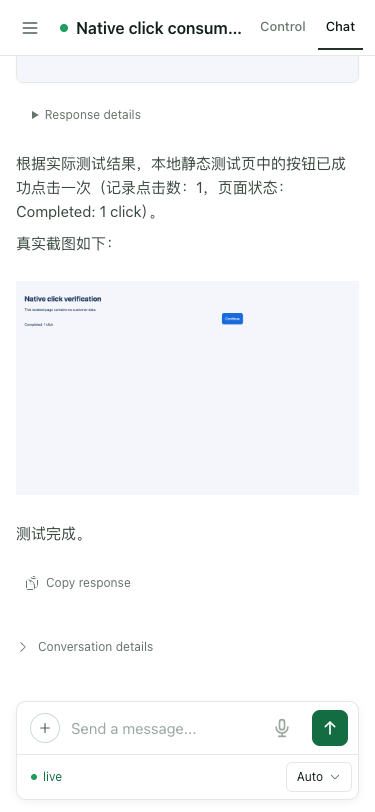
The unchanged capture above contains a generic local fixture. Its image and consumer evidence are described in the acceptance record. No O Chat layout change or before/after visual redesign is included.
Supervised browser jobs can refuse a replacement daemon
Set CO_BROWSER_DAEMON_PID to the verified local daemon's positive PID when
the supervisor owns startup. A missing, unavailable or replaced owner then
fails before command dispatch, automatic daemon startup or client installation.
The pin follows engine probes, reconnects and read keepalives. Whole-browser
close does not adopt a replacement owner for force cleanup. Explicit Host
private targets ignore the local pin; unpinned CLI startup stays unchanged.
An explicit install-onion is still an installation request.
Use a private endpoint/profile and verify the account and paid session separately. The PID is a lifecycle constraint, not authentication or a session identifier. See the browser documentation.
The new regression cases passed 21 tests; the related browser suite passed 90. A real CLI trial listed zero tabs, refused navigation after owner loss and replacement, preserved the new owner and exited both owned daemons. It opened no page or paid session. It does not establish production namespace acceptance.
A project Host watches only the handoff store it owns
Host startup now passes its resolved configuration directory to the handoff watcher boundary. A different project directory does not start the ambient global watcher. A matching configured directory keeps normal start/shutdown; the owner's explicit CLI watcher remains unchanged. This does not introduce project-scoped handoff queues, reset historical records or replay handoffs. The expanded ownership suite passed 145 tests.
The design stories explain click pacing, supervised browser startup and Host handoff ownership.
Install
python -m pip install --upgrade 'connectonion==1.9.3rc16'
Use the exact pin in a Python 3.11+ environment. A preview remains opt-in and does not change the stable installation recommendation.