 ConnectOnion
ConnectOnion 1.9.0a14 (preview)
This preview includes the connected, task-first reader from 1.9.0a13 and makes REM's first run investigate a useful recent set of memories by default.
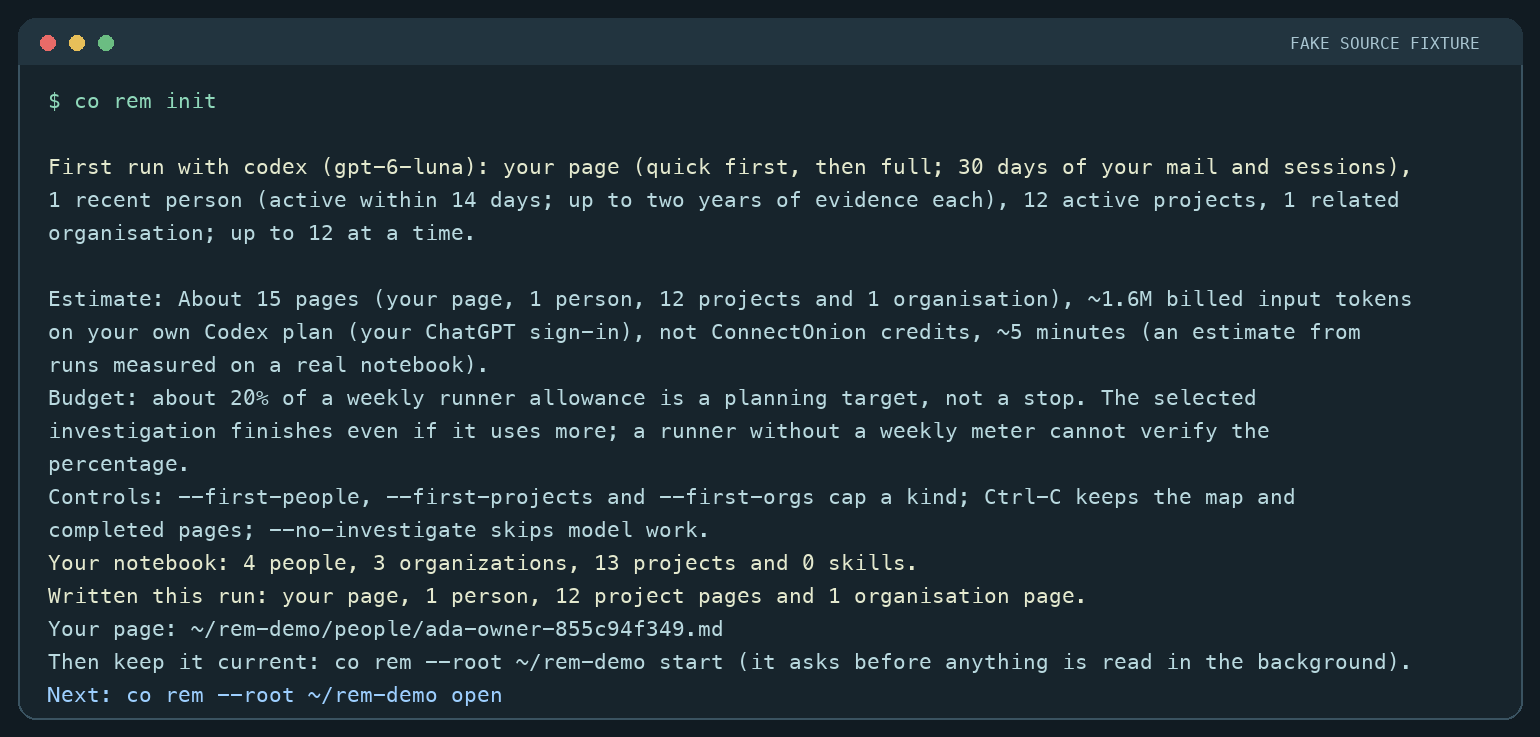
co rem init maps connected sources, writes the owner's page, then investigates
recent important people, active projects, and organizations linked to those
people. It does this in a terminal, a script, or --json; --no-investigate
explicitly requests a map-only run. The initial announcement estimates pages,
tokens, and time before model work.
The estimate counts both owner turns and the last slow page in a parallel
wave; it uses medians from the notebook's own runs when available.
Roughly 20% of a weekly runner allowance is a target for the first run, not a hard cap. The selected investigation can continue beyond that target; the configured weekly safety floor still stops new pages when the runner has a readable meter. Codex's meter reports whole percentages. Claude Code and other runners without a readable weekly meter cannot report a measured percentage. Manual and scheduled investigation keep their configured weekly budget.
The bundled rem-init Skill is short and points to the CLI workflow; the
investigation runner invokes its stage Skill once rather than repeating the
entire core in every task prompt. Its page addenda now agree on the History
limit and order, preserve the runner-owned status footer, and keep the quick
first pass within its supplied sample. Optional mailbox follow-up is explicitly
runner-mediated. Selected person pages may search up to two
years of evidence. The first run runs pages concurrently, keeps completed pages
when another is refused or one archived mail body is unavailable, and preserves
the ability to retry individual failures. The reader adds labels for personal
and sensitive sentences and a local “Hide private” control.
The map and all source bodies remain local to the notebook. A successful command does not establish that every model claim is correct: inspect cited sources and unresolved sections. The reader is still a read-only snapshot, and the broader page-template design review in #2065 remains open.
Verification
In a private local seven-day first-run trial, init selected 27 pages: the owner, 12 recent people, 11 active projects, and 3 related organizations. The first pass accepted 26 pages and refused one person page because its History had ten milestones against an eight-milestone limit. The repaired runner retried that page and it was accepted. All 27 accepted pages have source entries and none retain the uninvestigated placeholder. Median page length was 4,801 characters and median citation-marker count was 61. Those checks measure coverage and traceability, not factual correctness. The trial used the owner's connected sources in a private temporary notebook; no source text or personal page was published as test evidence.
The first pass recorded 7.66 million billed input tokens and took roughly 13 minutes including mapping. Its older default estimate understated the work, so this candidate recalibrates per-kind defaults from that run and counts the owner's two model turns. Actual time and cost still vary by source volume, runner, and model. The final package and browser gates are recorded in the release PR before tagging.
A second private seven-day init from the installed 1.9.0a14 wheel selected
27 pages and accepted all 27 without a refusal. After the prompt correction,
an installed-wheel investigate me --quick also completed and changed its
page with the quick sample only. These runs used connected private evidence;
the public screenshots use invented data.